
Building Literacy, Confidence and Lasting Capacity: A.R.R.O.W. and the Scotiabank Trinidad and Tobago Foundation

Literacy is so much more than the ability to read and write. It has the potential to shape a child's confidence, independence and opportunities throughout life. Yet, for children who struggle to learn through conventional teaching methods, finding the right support can make all the difference. Through its partnership with the Scotiabank Trinidad and Tobago Foundation, A.R.R.O.W. is working to address these challenges through a combination of targeted literacy interventions, teacher training, and holistic support for children and their wider learning communities. At the heart of this work is a recognition of each learner's individual needs and equipping the people around them with the tools to help them thrive.
The programme has been delivered across four schools through this collaboration – last year, the A.R.R.O.W. team worked with Tranquillity and Agostini KPA Primary Schools, where teachers completed their training, carried out supervised A.R.R.O.W. interventions with students together with A.R.R.O.W., and worked towards their official certification as A.R.R.O.W. tutors. This year, the partnership has extended to Aranguez Government Primary School and Esperanza Presbyterian Primary School, where the next round of teacher training is beginning.
Alongside these activities, the partnership includes the Read Aloud Programme, workshops for parents and teachers, the provision of laptops and software, and the creation of dedicated literacy corners within schools. Together, these strands form a longer-term approach to literacy support: working directly with children while building the capacity of teachers and schools to sustain the programme into the future.
The A.R.R.O.W. Literacy Programme: Supporting Every Learner


At the heart of the partnership, is the A.R.R.O.W.™ Literacy Programme, which provides targeted, individualised support to help children strengthen their reading and spelling skills. Students are assessed using the Schonell Reading and Spelling assessments, allowing interventions to be tailored to their individual learning needs. Through an eight-hour programme, a combination of one-to-one tutor support, computer-based multisensory learning tasks, and A.R.R.OW.'s central Self-Voice technology, the student's own voice is used to reinforce speaking, listening, reading and writing skills. The approach subsequently and significantly improves comprehension, attention, memory, motivation and confidence, and literacy skills. Through the partnership and wider programme with Scotia, teachers and parents are further engaged to help sustain progress beyond the sessions.
The programme has already recorded measurable literacy improvements across both participating schools. Students entered the programme with literacy levels that were, in several cases, substantially below chronological age, with some requiring additional support. Their improved results in both reading and spelling ages offer an encouraging and promising starting point, for students who were showing no measurable improvement in their literacy levels, from day to day traditional educational routines at school. Many teachers specifically noted how much of a difference they noticed in students' enthusiasm to learn and confidence in the classroom. With this partnership and programme, students are able to continue to access the programme, with licensed A.R.R.O.W. computers, teachers trained in the A.R.R.O.W. method and dedicated literacy spaces, providing a wider support structure around participating learners.
"This term, students from Infant 2 to Standard 4 participated in the intervention. Based on teacher assessments, the programme delivered clear and measurable results in academic progress and in confidence and engagement. A consistent theme across all classes was increased self-confidence and enthusiasm for literacy. Students were reportedly "eager to attend sessions" and showed a more positive attitude toward reading."
– Ms Kendra Deo-Mohammed, Principal Primary at Esperanza Presbyterian School
The Read Aloud Programme, and approaching literacy support from the perspective of the 'whole child'

Reading aloud is an important part of helping children develop their literacy skills. It gives children the opportunity to hear language spoken, engage with stories and begin to make connections between the words they hear and the words they see on a page.
As part of this partnership, A.R.R.O.W. and Scotia Trinidad and Tobago Foundation team members delivered Read Aloud sessions at Esperanza Presbyterian Primary and Aranguez Government Primary Schools. Scotiabank senior leaders joined ARROW representatives to share stories, including local children's literature, Trevor the Golden Tree Frog by Resha Ali and Lost at Carnival by Gail Morong. Through storytelling, discussion and shared reading, students explored themes of equality and storylines that were relatable and engaging, while developing their listening, comprehension and critical thinking skills.
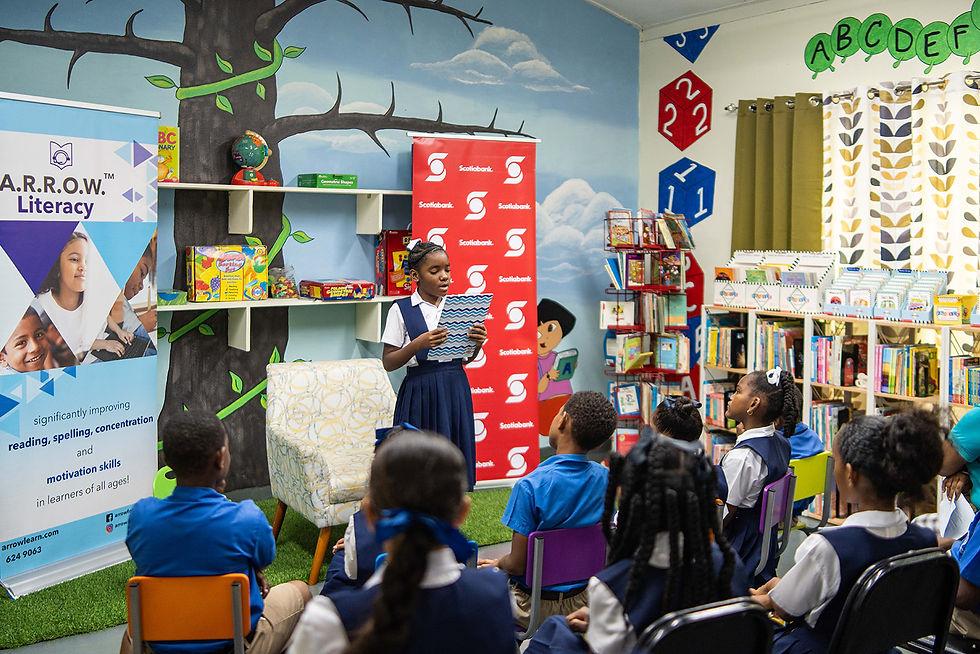
The sessions encouraged children to ask questions, share their ideas and build confidence in expressing themselves. As Scotiabank’s Reshard Mohammed reflected, “a shared story can do much more than build knowledge – it can spark curiosity, strengthen confidence and encourage children to express their ideas.” The programme forms part of Scotia Foundation’s wider commitment to education and youth development, alongside ARROW’s work to strengthen literacy holistically and consider 'the whole child' within supporting literacy development.
Throughout this partnership, workshops led by Cornelia Bonterre from Waking Up The Children, brought parents and teachers together to explore brain-based learning, trauma-informed approaches and ways of supporting children at home. These workshops are integral to A.R.R.O.W.'s aim of looking at 'the whole child' when addressing literacy concerns. It recognises that children's learning is shaped by a range of experiences and that the adults around them can play an important role in creating supportive learning environments.
Teacher Training: Building Literacy Support Within Schools
A central part of A.R.R.O.W.'s work with the Scotiabank Trinidad and Tobago Foundation is training teachers to become A.R.R.O.W. tutors. Rather than relying solely on external intervention, the programme aims to build the skills and capacity of teachers within participating schools so that they can continue supporting students themselves.
Beginning with an initial phase of work with children, this partnership programme invovles the A.R.R.O.W. team working directly with approximately 25 children in each school – intially providing teachers with an introduction to the approach and allowing them to observe the programme in practice.
In Phase Two of the programme, teachers at the participatong schools are trained ARROW intervention, throughout an intensive 2 day workshop delivered by the A.R.R.O.W. director Christopher Bonterre. Following this training, teachers then work alongside the A.R.R.O.W. team to put what they have learnt into practice with students in their own schools.
Teachers apply the methodology in practice, work with the programme's software, and prepare reports documenting their students' progress and alongside their own findings. These reports are then sent to A.R.R.O.W. Tuition in the UK for review, as part of the process of registering the teachers as offical A.R.RO.W. tutors.
Tranquillity and Agostini Primary Schools, teachers have completed this process and Agostini Primary's teacher's have now received their official certification.
By investing in teachers as well as students, the partnership is working towards a model in which literacy support becomes an ongoing part of school life.
"One of the strongest indicators of the programme's success was the excitement it generated throughout the school. Students who were not part of the programme repeatedly asked if they could join after seeing the enthusiasm and progress of their classmates. Their desire to become part of A.R.R.O.W. speaks volumes about the engaging, supportive, and motivating environment the programme creates."
– Nigel Clarke, Principal of Aranguez Primary School
Celebrating Achievement: Official A.R.R.O.W. Tutor Certification

As trained tutors, teachers can use the A.R.R.O.W. approach and resources to deliver structured literacy interventions, monitor students' progress and build on the learning gained through their training. They also form part of a larger alumni network of tutors, trained throughout the Caribbean and UK, and gaining access to a variety of resources.
Laptops and Literacy Corners: Equipping Schools for the Future


The provision of laptops, licensed A.R.R.O.W. software and dedicated literacy corners is another important part of the partnership's approach: equipping schools not only to participate in a programme, but to build the knowledge, resources and confidence needed to sustain the work themselves.
These resources are intended to remain with the schools. The longer-term aim is for each school to have the A.R.R.O.W. programme in place for five years, giving teachers time to use the software and develop their own capacity to deliver literacy support.
Looking Ahead: Continuing to Build Literacy
Lasting change in literacy takes more than a short-term intervention. It requires time, resources and a commitment to supporting the children who need it most, while equipping teachers, parents and school communities to continue that work. Through its partnership with the Scotiabank Trinidad and Tobago Foundation, A.R.R.O.W. is building towards a model of literacy support that extends beyond individual sessions, creating opportunities for children to develop their literacy skills, confidence and independence over time.
This is what A.R.R.O.W.'s work is all about: Working within the existing educational systems to make learning more accessible, engaging and empathetic, considering the multiplicity of learners and their individual circumstances, and ensuring that more children have the support they need to find their voice and realise their potential.


Comments